Gaviotas, the model village
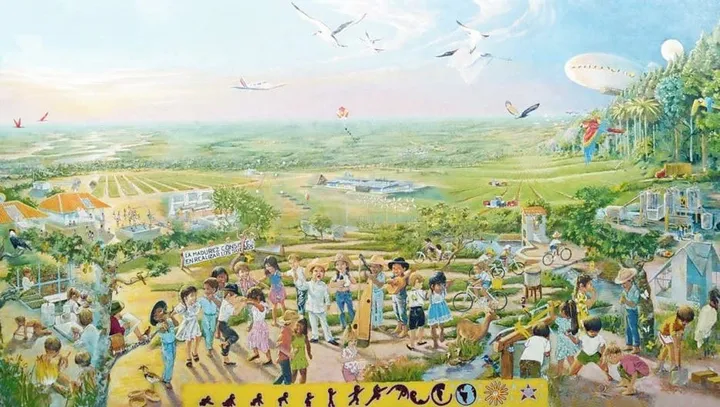
I was searching one day for a sustainable building system, when I discovered a hint of the perfect community. I don’t remember exactly what I was searching for, but it has been on my mind to develop communities amongst the world’s poorest, that are truly sustainable in every sense.
My experiences to date, are of communities that receive donations from the richer nations and so they gradually appear richer but they have not done anything to earn the wealth. And so they feel no responsibility to change what they are doing.
Some of the most effective changes seem to be brought about by returning ex-pats. They were possibly born and/or raised in a wealthy developed nation, they have worked a normal job, or in some cases a successful career, and then they return to their homeland ready to invest their savings.
This is really an outside investment strategy, except there is a bit more influence that can be exerted by being a native. The results however are also likely to be limited to the amount of investment that can be attracted. Although a successful business can be built, it still has its origins in outside investment being brought in.
I discovered a community called Las Gaviotas through a speech given by Gunter Pauli, author of the book The Blue Economy. He is often invited to speak at sustainability conferences. And so it was that he introduced the village and concept of Gaviotas to me, together with his concept of the blue economy.
I immediately bought the book by Alan Weisman: Gaviotas, a Village to Reinvent the World. This article will briefly describe the contents of this book and my thoughts.
Las Gaviotas
Las Gaviotas is known as an Ecovillage and is located in the Llanos region of Columbia. It is a savanna region of grasslands near the Columbian rainforest but known as a place where only grass grows. The original plan from the early seventies was to see if it could be made habitable and so house a growing population. There was, however, no infrastructure, no roads, no electricity, so they had to build from the ground up.
Paolo Lugari is the visionary behind the project and with only a vision and enthusiasm was able to convince engineers and scientists from Bogota to venture up there and see what they could accomplish.
What they did accomplish was quite amazing developing a compressed earth-block tool for making bricks, much the same as I’ve discussed elsewhere. Then they revolutionized well digging and pumping by taking cheap, easily available materials and finding ways to pump clean water up from as deep as 40m below the surface, a depth far exceeding what was previously possible with hand pumps.
Access to clean water is one of the primary ways of improving the quality of life for millions of the poorest people around the world. Clean water can massively increase health, and prevent the death, of huge numbers of people. Simply taking care of the water supplies removed the need for expensive medicines and medical facilities.
In the early days, Las Gaviotas survived on grant money from the UN, the World Bank and paid projects with the Colombian government. Often they participated in projects to bring fresh water to villagers throughout Columbia, or they delivered solar hot-water systems to housing developments in Bogota. With such projects, they were able to finance other development projects and attract additional scientists and engineers. And so the community grew.
The Technologies
In 1991 the UN Development Programme published a book entitled Development without Poverty. It was about technologies that could transform the prospects of the poor around the world. Fifty of the technologies featured had originated at Las Gaviotas.
Windmills
Gaviotas powered various items by Windmill. The development itself took many years and of fifty prototypes because it needed to be light enough to provide power at times of low wind-speed and strong enough to survive in times of strong winds. It also needed to be simple to build requiring only basic tools. They succeeded but there is a cost associated with it, they require aluminium for the blades, for example, bringing the cost per windmill to about $500. The windmills are often used to directly pump water from wells.
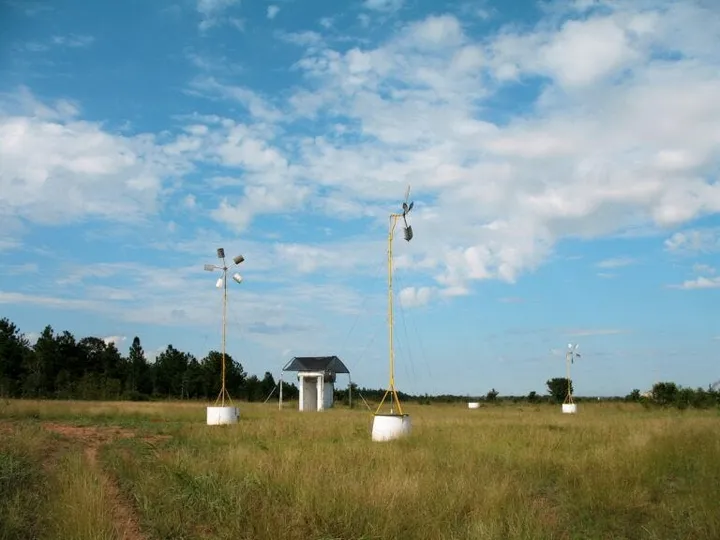
Gaviotas windmills, from www.centrolasgaviotas.org
Soil Cement
Soil cement is a form of concrete made by mixing soil with a binder like lime or Portland cement. It was the starting point for the compressed earth block development. It was not developed by the Gaviotans but by Columbia’s Universidad Nacional who called the compression machine the Cinva ram. They made a cement mixture using fourteen parts soil and one part Portland cement.
They later found that they could make a mixture for pouring that had similar properties to traditional concrete. They could build drainage systems by digging an open channel, inflating polythene tubing and pouring the concrete mixture over the top. After it had cured, they simply deflated and removed the plastic tubing.
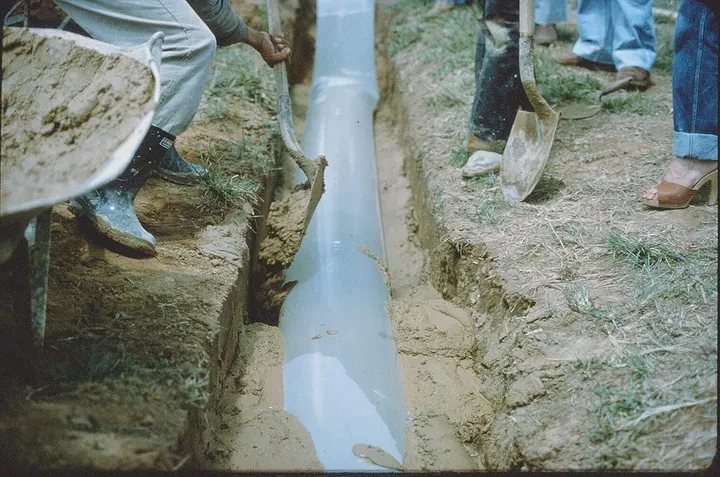
Gaviones, from www.centrolasgaviotas.org
Bicycles
Gaviotas developed their own bicycles and had them made to specification by a factory near Bogota. That was the primary means of transport for the villagers, but they also converted bicycles to power other equipment such as cassava grinders. This reduced a 10-hour job of hand-grinding cassava, down to a 1-hour job. Unfortunately, it didn’t catch on as women were not accustomed to riding bicycles and so it became an additional task for the men.
Micro-turbines
They developed a micro-turbine that can be placed into a nearby river or stream to produce electricity.
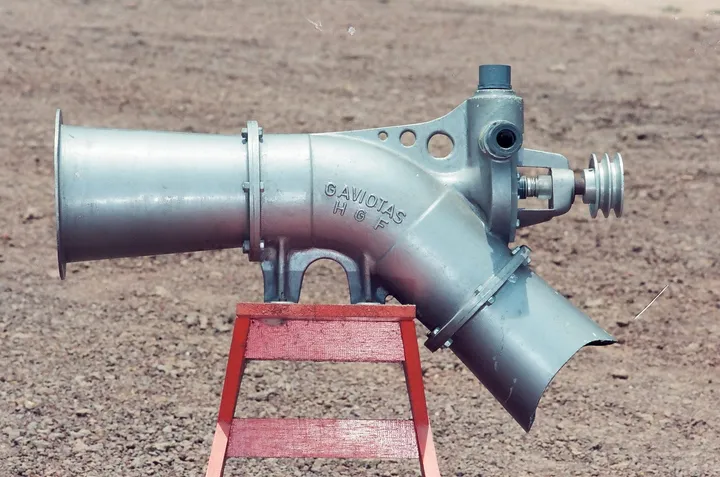
Gaviotas microturbine, from www.centrolasgaviotas.org
Biogas Generators
They developed generators that ran from biogas. The biogas came from manure from the cattle that was mixed with water and diverted into a chamber where methane is produced.
Later they developed biofuels from the resins of the trees.
Solar water heaters
The water heaters that they produced were so effective that they even worked on cloudy days and could provide an entire apartment block with hot-water. This became one of their early money-earners.
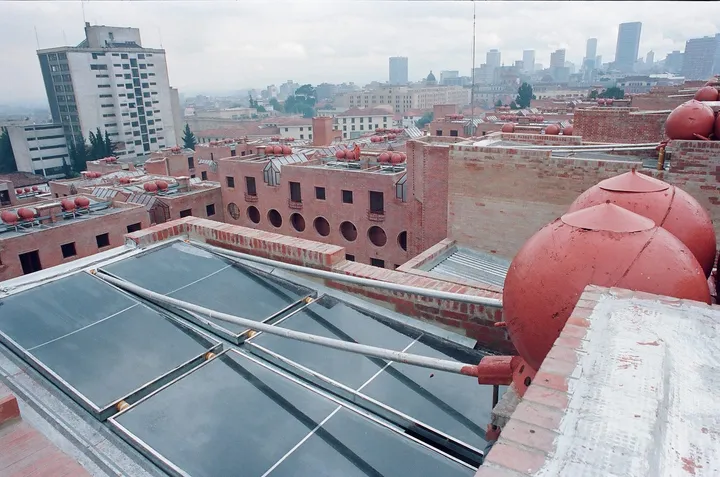
Gaviotas solar water heaters, from www.centrolasgaviotas.org
Solar Kettles
The solar kettle is really a solar water purifier. It combined the solar water heaters with a heat exchanger, a water pump and a storage tank. This would then heat water to sufficient temperatures to achieve pasteurisation and feed this water directly into the storage tank so that a constant supply of purified water is available.
Hydroponics
The process of growing plants in a liquid substrate containing all the essential nutrients was pioneered at Gaviotas as they tried to grow salad in this very harsh environment.
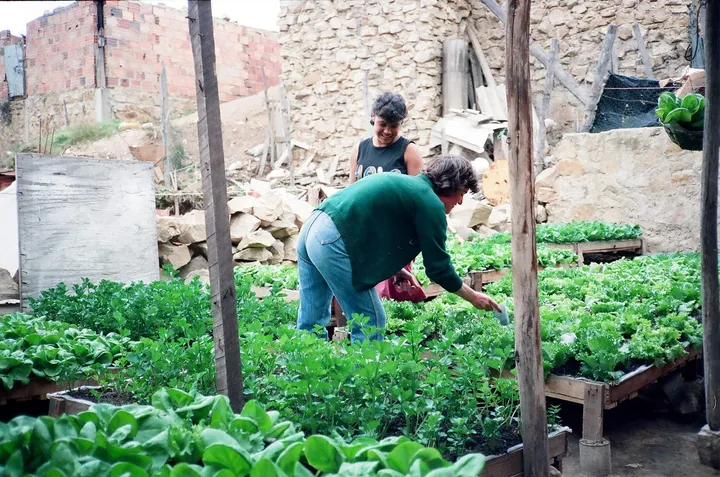
Hydroponic beds, from www.centrolasgaviotas.org
Solar Fridge
The solar fridge is a novel idea that I’ve been unable to find further information about. Essentially they made it work but it involved the use of some dangerous chemicals, not too dissimilar to every fridge. At the time the chemicals caused corrosion of the metals and were known to explode. I’m not sure whether they ultimately solved the problem, but I imagine it could be solved with modern materials. The system worked by simply using the heat of the sun to expand the gas and thus extract heat from within the fridge. I have seen elsewhere that something akin to a cool pantry can be created by building a wooden shed, insulating it with charcoal and then applying a light coating of water, usually dripped from above. The evaporation of the water causes the inside of the shed to be at least 5 degrees cooler than the outside of the shed.
I found that the Amish often use old chest freezers and ice either harvested in Winter or bought from local suppliers. I’m not sure what would be appropriate for villages, the shed idea is probably the cheapest and easiest for now.
Reforestation
A lot of the early technologies were developed by scientists and engineers paid for using UN grants. At the same time, the Gaviotans kept in mind their plan to populate the Llanos. They found that Carribean Pine trees were about the only thing that would grow in the Llanos but in allowing them to grow without the use of herbicides and insecticides, they created a diverse forest that grew symbiotically. Not only was the forest thriving, but the native species of flora and fauna from the rainforest were gradually returning to the region. The soil itself was being regenerated by the presence of the pine trees and in the absence of harmful farming practices new growth could occur.
The pine saplings were grown in the hydroponic greenhouses and planted using as many helpers as they could find trailing behind a tractor. They were not against technology but they were against harmful practices. They’d learned that when transplanting the saplings the Venezuelans would wrap the roots in plastic bags for transportation. This created plastic waste and damaged the roots because of the humidity and bending. The Gaviotans found a clay mixture that would prevent the roots from drying out, resulting in zero waste and stronger early growth.
Later palm trees were introduced to harvest palm oil and create biodiesel for running their tractor. They also introduced Neem trees to harvest the oil for medicinal purposes. Neem oil at the time sold for more than cocaine on a per-gram basis.
Learning
The book is now twenty-five years old and describes an era older than that, but there are lots of things that we can learn from this pioneering community.
A community needs to be self-sustaining. This was not a natural community growing from a family or tribe but rather one that formed around a vision. It was therefore not as cohesive as a tribal community would be, nevertheless, tribal communities fail to prosper because of competition from modern practices. What I mean is that the tribes lost their native lands because of ranchers and farmers building fences. The water supplies can become tainted because of increasing industrial uses. Diseases can quickly spread without healthcare, and families break apart as people seek modern advancements. If some of these advancements can be brought to the community with only the addition of some simple technologies then maybe the communities can remain together in better health and prosperity. I think this means that there needs to be some form of industry that the community can perform together to bring an income, finance advancements and give some incentives to the next generation.
Education can be simple and creative. Gaviotas built a school and many villages for miles around sent their children there. But they needed to pay for the school, the materials and the teachers. I believe education is a privilege, not a right, but it doesn’t need to be out of the reach of everyone. I believe education should be appropriate for the community and for the pupil. Some pupils only need to learn one skill and they will apply that skill for the rest of their lives, others will learn languages and mathematics and may go on to University, although for these communities they maybe just need a builder, a roofer, a handy-man who can repair pumps and windmills, or a creative engineer to can develop new tools. Education does need to be paid for and therefore there needs to be some form of economy. Education should focus on what is useful and what can be applied in the local context. Greater learning can be made available to those gifted in that way maybe with the community sponsoring the most talented individuals.
Infrastructure is important. The Llanos is several hours from Bogota with only dirt tracks for access, although there was an airstrip there. The airstrip was in regular use as visitors came and went and with residents having projects to complete in Bogota. This became more of a concern as they developed industries such as producing resin from pine trees and building solar water heaters. The lack of good quality roads or other transportation increases the cost of doing business. Ultimately the solar business was moved to Bogota.
Outside influences can seriously impact viability. In the early years as grants were made available then growth was quick but local government decisions to cancel projects such as rural investment schemes and further afield factors such as the price of oil determined whether the community was viable or not. This was demonstrated in the book as a trade agreement with the US was negotiated allowing large-scale US farms to compete with locally grown produce. Wikipedia describes how even the resin business that was previously thriving was brought down by China flooding the market https://en.wikipedia.org/wiki/Gaviotas. Unfortunately, Governments should be protecting the interest of their citizens, but more often than not they are pressured into making policy decisions that benefit a small minority including themselves. I envision a community that is able to enrich itself free from the interference of Government. They should not need to compete in World markets, or even country-wide, they just need a product (or several) that is useful within the local community. In the grander scheme, there needs to be some product of value to allow trading for raw materials not available locally. This economic system will not lead to the cheapest or even best products but should lead to a more equitable community.
Obstacles can be overcome. With some out-of-the-box thinking then very innovative solutions can be found to make things better, cheaper, or more efficient than before. Economic, or systemic problems can be overcome with flexibility, willingness to change and some perseverance. I believe in a sharing economy such as crowd-funding or crowd-sourcing. Today it should be easier than ever to overcome problems and to find novel solutions. Gaviotas was fortunate to have access to some brilliant creative engineers and scientists but they did not have access to a database of the world’s knowledge. With the Internet, it should be easier than ever to succeed.
Ownership matters. The book describes several instances where tribal communities had let developments fall into disrepair. Usually, these were hand-pumps but also bicycle grinders and other tools. Every technological innovation requires some maintenance to keep it in good repair. The hand-pumps, although simple, required gaskets. The gaskets could be made from leather. The problem was that the communities did not accept responsibility for their own water supply. Clearly more work needed to be done in finding a responsible steward, training the village on how the pumps work and educating the village on the benefits of clean water to their health.
Summary
So much can be achieved with outside investment, it is a shortcut to solving some big problems. However, it often introduces new problems. Some projects are too large to be done except with large investments, and some projects that receive investments may not result in enriching a community. Major beneficial changes can be brought about with smaller injections of education and funding.
I’ve been thinking about paper recently. In Uganda, I saw classrooms full of students without paper and pencils. Paper can be bought so cheaply in Europe, but when you have no tradable resource then it is not cheap. A community might be educated in how to produce paper from wood pulp, if they have wood. Or from cotton, or from bamboo, or many other sources. Maybe they could instead produce palm oil or neem oil so that this could be traded for paper. Initially, the focus should be on high-value goods, or using natural resources. Often the sun, the land or the trees form this resource. The sun and warmer temperatures can be used to grow many fruits and vegetables. Introducing new crops may not be culturally acceptable, but the simple addition of a cool storage facility may allow for a longer sales period without requiring a large upheaval from traditional agriculture.
I also suggest involving the entire community in the economy from a young age. Leave the brightest to excel in school whilst the rest learn practical skills in construction, clothing or agriculture.
Many talk the talk of the green economy and sustainability, but few practice it, or are even willing to invest in it. True sustainability involves learning to live with less, until we find truly sustainable techniques. Reject cheap imports and prefer enriching your neighbour. It’s easier said than done. Maybe your neighbour’s produce is of poorer quality than the import. A little bit of capitalism applied correctly may help. It’s not a simple job for governments to get policies right, I don’t envy them that task. “Love your neighbour as yourself” is all we can do. Be willing to be wrong and to learn and course correct. Start today. With these principles, we can all one day hope to live in a topia.
Comments